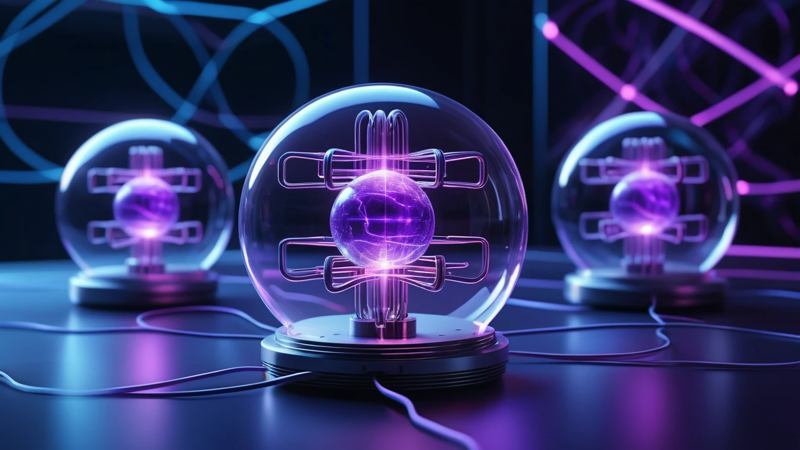
Quantum Computing Explained Simply – A Beginner-Friendly Guide
Quantum computing explained simply. Learn how quantum computers work, why they matter, and how they’re changing the future—easy and beginner-friendly.
Quantum computing is a new type of computing that uses quantum bits (qubits) to process information. Unlike traditional computers that use 0s and 1s, qubits can be both at once, making quantum computers extremely powerful for solving complex problems faster than classical computers.
Have you ever wondered how scientists might solve problems that are impossible for even the fastest supercomputers today? Or how new breakthroughs in medicine, finance, and space exploration might become possible? That’s where quantum computing comes in — a technology that sounds complicated, but can be understood with the right explanation.
At its core, quantum computing is about using the strange rules of quantum physics to process information in a completely new way. While traditional computers rely on binary bits, quantum computers use qubits, which can do much more — and much faster.
Let’s break it down simply and explore how quantum computing works, why it matters, and what the future may look like. 🌍⚡
What Is Quantum Computing? 💡
Quantum computing is a new form of computing that takes advantage of quantum mechanics — the science that explains how particles behave at the smallest levels. While a normal computer uses bits that are either 0 or 1, quantum computers use qubits, which can be 0, 1, or both at the same time.
This ability to be in multiple states at once allows quantum computers to perform many calculations simultaneously. That means they can solve certain types of problems much faster than classical computers.
How Traditional Computers Work 🖥️
Traditional computers use binary bits.
A bit is the smallest unit of data and can hold a value of 0 or 1.
When you open an app, save a file, or play a game, your computer is processing millions of bits switching between 0s and 1s.
Key Characteristics:
- Uses transistors
- Binary data system
- Reliable for everyday tasks
- Limited when solving highly complex problems
What Makes Quantum Computers Different? 🧠⚛️
Quantum computers store and process data using quantum bits (qubits).
Unlike bits, qubits can exist in multiple states at once due to a property called superposition.
This means a quantum computer can test many solutions simultaneously rather than one-by-one.
Why This Matters:
- Speeds up problem-solving
- Enables new scientific discoveries
- Handles complex simulations with ease
Understanding Qubits – The Heart of Quantum Computing 🔄
A qubit is the basic unit of information in quantum computing.
Think of it like a spinning coin — while it spins, it’s neither heads nor tails, but both at the same time.
This ability allows quantum computers to work with multiple possibilities at once.
Comparison of Bits vs. Qubits
| Feature | Bit (Classical Computer) | Qubit (Quantum Computer) |
| Data State | 0 or 1 | 0, 1, or both at once |
| Processing | One calculation at a time | Many calculations simultaneously |
| Speed | Limited | Extremely fast for complex tasks |
| Used For | Everyday computing | Scientific and advanced computing |
Key Quantum Principles That Make It Work ✨
Quantum computing is built on three important principles:
- Superposition – A qubit can be in multiple states at once.
- Entanglement – Qubits can become linked so changing one instantly affects another.
- Interference – Quantum behavior can be controlled to produce the right outcomes.
These effects allow quantum computers to do tasks impossible for normal computers.
Why Quantum Computing Is So Powerful ⚡
Quantum computers don’t just do things faster.
They do things that ordinary computers cannot do at all within a human lifetime.
They excel at:
- Pattern recognition
- Optimization (finding the best solution out of many)
- Large simulations, such as modeling molecules or weather systems
Real-World Applications of Quantum Computing 🌍
Quantum computing isn’t just theory — it has major real-world potential.
Some Powerful Uses:
- Drug discovery: Simulating molecules to create new medicines.
- Climate modeling: Predicting weather with extreme accuracy.
- Cybersecurity: Creating nearly unbreakable encryption.
- Finance: Optimizing investment strategies.
- Artificial intelligence: Enhancing machine learning algorithms.
Quantum Computing in Medicine 🧬
Quantum computing could revolutionize healthcare by simulating how molecules behave in the body.
This may lead to:
- Faster drug development
- Personalized treatments
- More effective diagnostics
Imagine curing diseases years faster than today.
Quantum Computing in Finance 💹
Banks and financial institutions are investing heavily in quantum tech.
It can improve:
- Fraud detection
- Risk management
- Market prediction
- Algorithmic trading
Example Simulation Comparison
| Task | Traditional Computer Time | Quantum Computer Time |
| Portfolio Optimization | Weeks | Minutes |
| Fraud Pattern Search | Days | Seconds |
Quantum Computers and Artificial Intelligence 🤖
AI relies on analyzing huge datasets.
Quantum computers can speed this process up and enable smarter, more powerful AI systems.
This means:
- Faster training of neural networks
- More accurate predictions
- Better automation capabilities
Challenges of Quantum Computing ⚠️
Quantum computing is still in the early stages.
Current Limitations:
- Qubits are delicate and lose information easily.
- Systems require extremely cold environments.
- Very expensive to build and maintain.
Researchers worldwide are working to solve these issues.
Quantum Computing vs. Classical Computing 🔁
Quantum computers won’t replace classical computers.
Instead, they will work alongside them.
Classical computers handle:
- Everyday tasks (browsing, apps, gaming)
Quantum computers handle:
- Advanced scientific and complex problem-solving
The Future of Quantum Computing 🚀
Tech companies like Google, IBM, and Microsoft are racing to build stable quantum computers.
Within the next decade, we may see:
- Quantum-powered cybersecurity
- Quantum-enhanced AI systems
- Solutions to climate and medical challenges
The future is bright — and exciting.
How You Can Learn More or Get Started 🎯
You don’t need to be a scientist to start exploring this field.
Beginner-Friendly Steps:
- Watch short videos explaining qubits.
- Experiment with free cloud-based quantum simulators.
- Follow major quantum research companies online.
Conclusion 🎉
Quantum computing is not just another tech trend. It is a breakthrough that changes how we solve problems. By using qubits instead of bits, quantum computers can process many possibilities at once, opening doors to new scientific discoveries, medical breakthroughs, advanced AI, and more. Though still developing, the potential impact is enormous — and the future is closer than we think.
FAQs
- What is quantum computing in simple terms?
Quantum computing is a type of computing that uses qubits, which can hold multiple states at the same time. This allows quantum computers to solve complex problems faster than regular computers. It’s useful for science, medicine, and AI. - How does a qubit work?
A qubit can be 0, 1, or both at once due to quantum superposition. This makes it more powerful than a classical bit. When qubits connect through entanglement, they process information very quickly. - Why is quantum computing important?
It helps solve problems too complex for normal computers, such as drug discovery, climate prediction, and cybersecurity. It offers massive speed and efficiency. - Will quantum computers replace normal computers?
No, quantum computers will not replace regular computers. They will be used for specialized tasks, while everyday computing will still rely on classical systems. - Who is leading the development of quantum computing?
Companies like Google, IBM, Microsoft, Intel, and several research labs are leading quantum computing advancements. Many universities and governments are also investing heavily.